
Using AI for Bible Study Prep: What It Can Do, What It Can’t, and Why the Difference Matters
AI’s “Right Enough” Risk for Ministry Preparation
A few months ago, a global theological education organization asked me to lead a panel discussion on artificial intelligence and ministry preparation. The fact that they asked tells you something: AI is already reshaping how pastors and teachers prepare — not in theory, someday, but right now.
Here’s what I told them — and what no one in that room expected to hear: the real danger is that AI gets it right enough. Right enough that you stop wrestling with the text yourself. Right enough that you walk into the room with fluent answers you haven’t earned. That it sometimes gets theology outright wrong is a secondary concern. The subtler cost is what happens when it gets close enough.
And your people can tell.
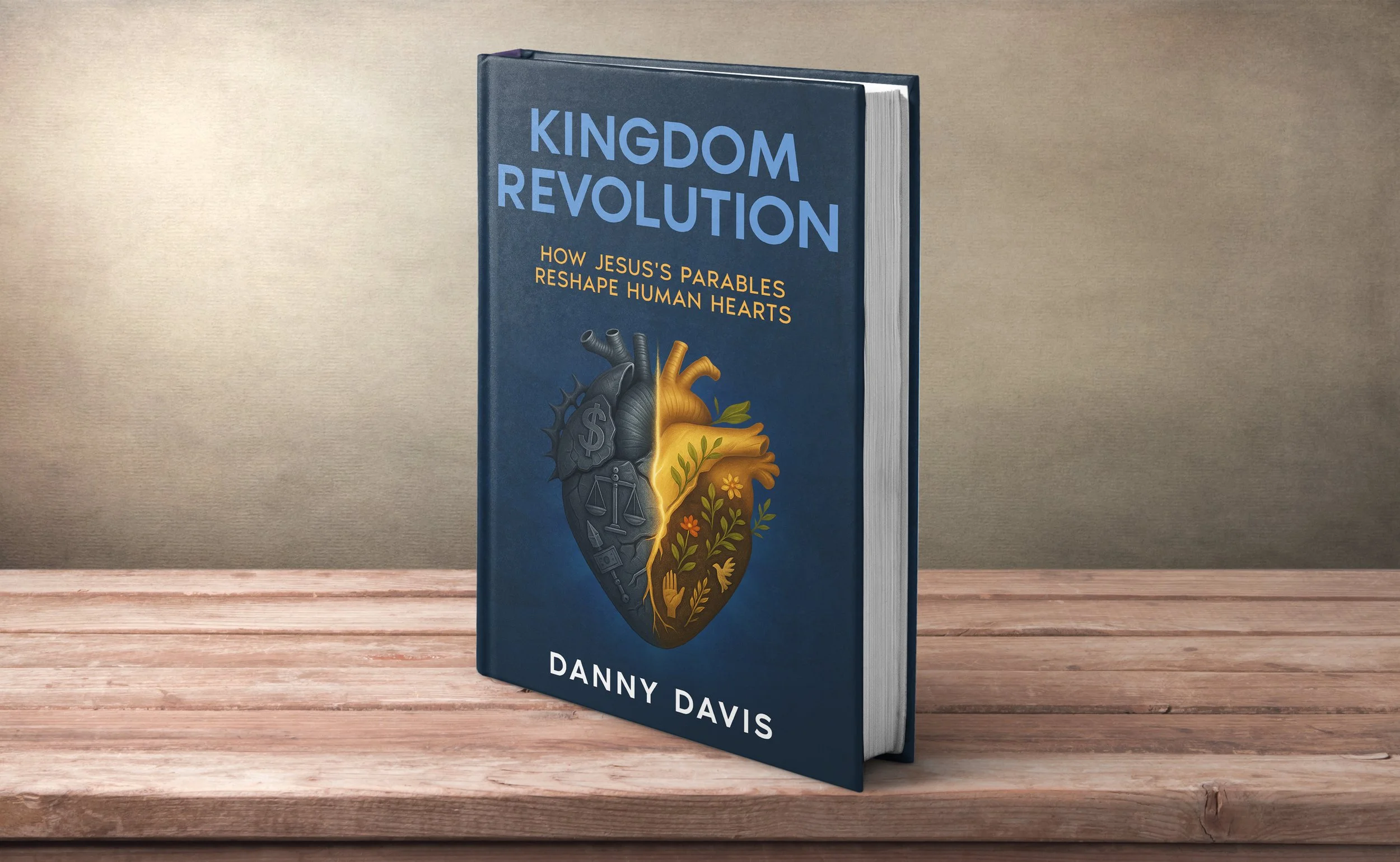
Click on the image to ORDER Kingdom Revolution (eBook & Paperback) from Amazon today!!
AI Is Already in the Room
Let me give you a sense of how far this conversation has already traveled.
A 2026 study by Barna Group, conducted in partnership with Pushpay, found that 60% of church leaders personally use AI at least once a month. But only 33% say their churches are using it in any formal ministry context. That gap tells a story: leaders are experimenting quietly, often without frameworks, policies, or clear thinking about what they’re doing.
Lifeway Research released findings this week — April 21, 2026 — showing that one in ten U.S. Protestant pastors are already regular AI users, and another third are actively experimenting. Meanwhile, 61% of churchgoers say they’re concerned about AI’s influence on Christianity. Church members and their pastors arrive on Sunday with very different relationships to these tools and almost no shared framework for navigating them.
Here’s the number that should stop every pastor and teacher cold: a separate Barna survey found that nearly one in three Americans say they find spiritual advice from AI as trustworthy as advice from a pastor.
One in three.
If people in your congregation are already consulting AI for spiritual guidance — and statistically, some are — the question is no longer whether to engage this topic. It’s whether you’ll help your people think clearly about it before the technology shapes their thinking for them.
This post is a working framework for teachers and pastors — practical and pastoral, aimed at your desk and your preparation, not at institutional policy or culture-war debate.
What AI Is Genuinely Good At
Start here, because the answer matters. AI is a real tool with real value in teaching preparation. Dismissing it wholesale serves no one. Used well, it reduces friction in the parts of prep that drain time without producing the formation you need.
Here’s where it earns its place at the desk:
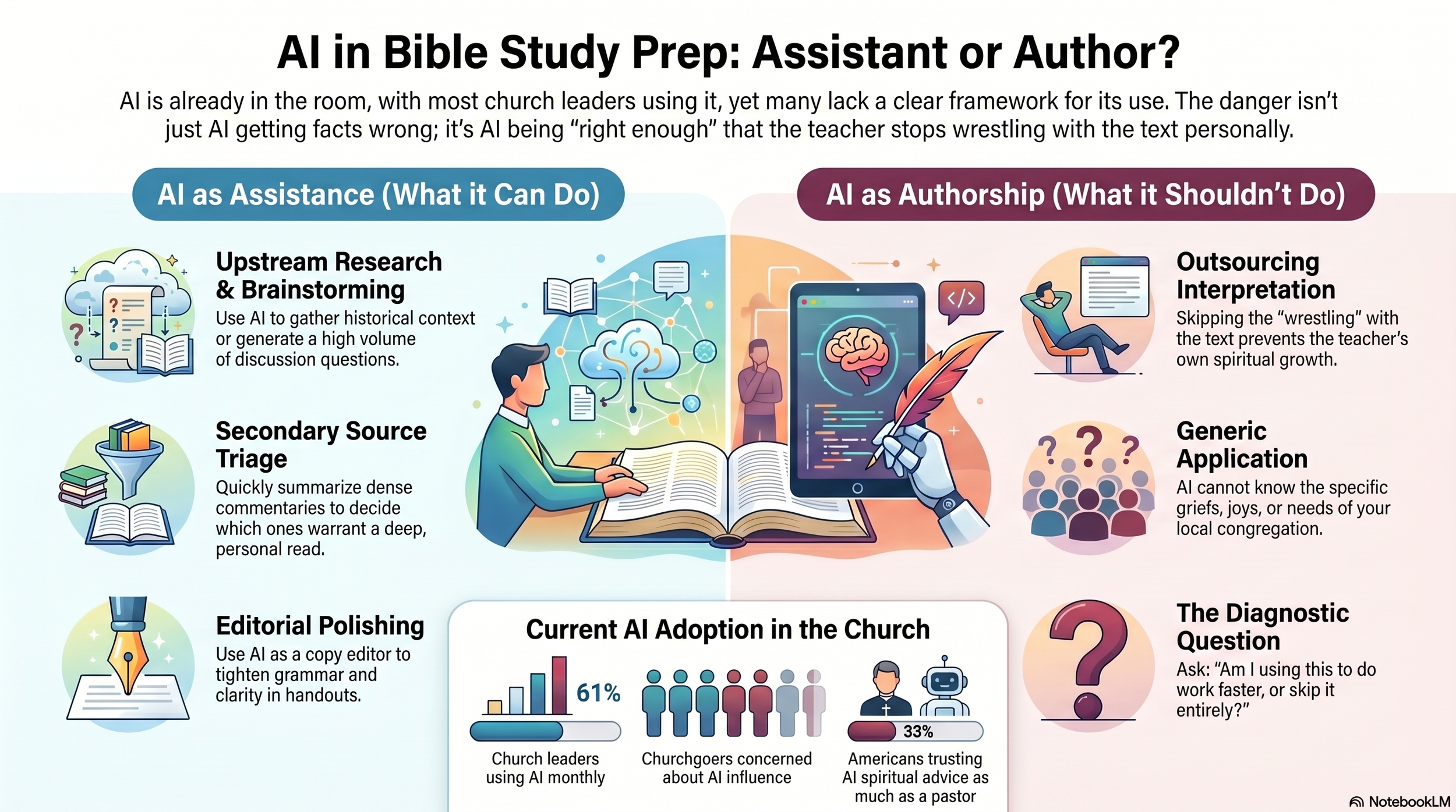
Background Research
The historical, cultural, and geographical context behind a biblical text used to require a stack of commentaries, hours of cross-referencing, and access to a serious theological library. AI compresses that time significantly.
Ask it to explain the Roman patronage system in first-century Palestine, the commercial culture of Corinth, the political pressures behind Pilate’s decision-making, or the honor-shame dynamics that shaped how Paul’s audience would have heard the Sermon on the Mount. You’ll get a useful orientation in minutes.
Use AI freely here. Background research is context-gathering, not interpretation. You still decide what matters for your text, what your group needs to know, and how to connect that context to the passage at hand. AI gives you the raw material. You do the theological work.
Here’s where it earns its place at the desk:
Brainstorming Discussion Questions
One of the most time-consuming parts of lesson preparation is generating a range of questions — especially questions that work at different levels of engagement. AI handles volume well. Feed it a passage and ask for twenty discussion questions ranging from basic observation to deep application, and you’ll have something to work with in under two minutes.
The key phrase is “work with.” Your job at this stage is editorial. Which questions serve this particular group? Which are too easy, too leading, or too abstract for where your people actually are? Which one cuts to the heart of what the passage is asking? AI generates the field of options. You make the choices. That editorial judgment is yours alone — and it’s exactly where asking great questions pays off.
Summarizing Secondary Sources
Dense commentaries and long theological articles take real time to read. AI can quickly surface a source's central argument, helping you triage: is this worth reading in full, or do I have what I need to move on?
Used as a first-pass filter, AI preserves your reading time for the sources that genuinely warrant depth. That’s a legitimate efficiency.
A standing caution: AI summaries of secondary sources can be imprecise, and occasionally they’re wrong in ways that sound authoritative. Always verify any claim that matters — a theological position, a historical detail, a scholar’s argument — before you carry it into the room. AI is a triage tool, not a research partner you can trust without checking.
Clarity and Grammar in Written Materials
Lesson handouts, small group guides, email summaries, and discussion guides for Sunday School — AI as a copy editor is low-risk and high-value. If you’ve written something and want it tightened, clarified, or adjusted for a different audience, AI handles this task well. The content is yours. The tool handles the polish. That’s a clean division of labor.
In each of these lanes, a useful shorthand holds: AI as assistance. The moment you move from assistance to authorship — the moment the tool is doing the thinking, not supporting it — something shifts. The next section is about recognizing that moment before it costs you.
Where AI Works Against You
The same capabilities that make AI useful in the lanes above make it quietly corrosive in others. What matters is what you’re asking the tool to do.
Writing Your Interpretation
When AI generates your exegesis, you’ve outsourced the most formative part of preparation.
The process of inductive Bible study is hard work on purpose. You sit with the text. You notice details that don’t immediately make sense. You ask questions that the text doesn’t answer right away. You come back. You sit some more. You wrestle with what Paul means in that sentence, why Mark structured this scene this way, and what was at stake in a moment you initially skimmed past.
That discomfort is the work. And the work is where teachers grow.
When you hand that discomfort to AI, you arrive at the text with someone else’s conclusions already formed. The deeper problem is that those conclusions arrive unearned. You haven’t wrestled your way to them. And when they’re wrong — as they sometimes are — you won’t have the judgment to catch it. Conclusions you haven’t earned don’t carry the same weight in the room.
Your congregation will feel the difference between a teacher who has wrestled with a passage and one who has processed it efficiently. They may not be able to name what’s missing. But they’ll sense that something is.
Producing Your Application
Application requires knowing your people. It requires understanding the particular struggles, blind spots, joys, and griefs of the specific community you’re teaching on a given Sunday in a particular season of their lives. AI doesn’t know your congregation.
What AI produces is a plausible application. Sentences that could fit anyone, anywhere, at some unspecified moment. Pastoral application is different. It requires knowing the particular person in the third row, the couple working through a hard season, and the small-group leader who asked you that question after church two weeks ago.
When you use AI to generate the “so what” of a lesson, you’ve removed the part of preparation that requires you to think carefully about the real people who will be sitting in front of you. That connection — between the ancient text and the specific life of a specific person in your community — is your irreplaceable contribution. No tool can make it for you. And when it’s missing, your people feel the gap even when they can’t explain it.
Short-Circuiting the Struggle That Forms You
The struggle of not knowing is where teachers grow.
Sitting with a hard passage, not yet understanding why Paul shifts tone in the middle of a chapter, not knowing how to explain the tension between two texts that seem to pull in different directions — this discomfort is generative. It drives you deeper into the text. It pushes you into commentaries, word studies, and prayer. It forces you to think more carefully than you would have if the answer had come easily.
AI eliminates that discomfort on demand. Ask it your hard question, and it will give you a fluent answer. Sometimes that answer is right. Sometimes it’s confidently wrong. In either case, you’ve skipped the process that would have formed you as a teacher of that text.
The teacher who skips that process not only produces a weaker lesson. They prepare themselves less. Formation happens in the wrestling, not in the answer. When AI hands you the answer before you’ve wrestled, it’s not saving you time. It’s costing you something you won’t immediately notice is gone.
Those three patterns share a common root. Naming it changes how you approach the tool.
This Is a Discipleship Issue, Not a Technology Issue
When I spoke to that global theological education organization about AI, I made a point that generated more discussion than anything else I said: this is a discipleship issue. The technology is the surface.
The question is what you’re building — and whether the tool serves the work or replaces it. Hammers are neither good nor bad. AI is no different in that regard.
Paul wrote to Timothy with a charge that still shapes how I think about preparation:
Do your best to present yourself to God as one approved, a worker who does not need to be ashamed and who correctly handles the word of truth. (2 Timothy 2:15)
A worker who does not need to be ashamed, whose handling of Scripture shows the labor of someone who takes it seriously. That is the standard. It is relational and formational, earned through engagement with the text, not outsourced from it.
The Barna/Pushpay study found something that should trouble every pastor and church leader: 64% of church leaders believe it’s important for churches to have an AI use policy — but only 5% actually have one. That governance gap is a failure of discipleship. It reflects an institution that has adopted a powerful tool without asking what it’s for, what it costs, and what it shapes in the one who uses it.
Before your church needs an AI policy, you need a personal framework for your own preparation. How you handle your own study time with these tools will shape how you think about them, how you guide your people, and what kind of teacher you’re becoming.
Pastors and teachers should be setting that agenda for themselves before anyone else asks them to.
The Diagnostic Question
Before every AI interaction in your teaching preparation, ask one question:
Am I using this to do the work faster — or to skip the work entirely?
Speed is fine. If AI compresses the time you spend gathering background context, brainstorming question options, or editing a handout, that’s a legitimate use. The preparation is still yours. The interpretation is still yours. The wrestling is still yours. You’re using a tool.
Skipping is costly. If AI is generating your interpretation, producing your application, or forming your conclusions before you’ve engaged the text yourself, something is being lost. What’s at stake is the teacher’s formation — something more costly than a mediocre lesson.
That distinction — AI as assistance versus AI as authorship — is where your discernment belongs. It won’t always be obvious in real time. There are gray areas and honest mistakes. But the question is a reliable guide, and it has a way of surfacing honest answers if you’re willing to sit with it before you move on.
Ask it before you start. Ask it again when you notice you’re moving faster than feels right.
A Practical Rule for the Desk
Here’s the rule I’ve landed on, and the one I offered to that panel: let AI inform your preparation. Don’t let it become your preparation.
Use it upstream. Background research, brainstorming, secondary source triage, and editorial polish on written materials. In each of these, you’re the one thinking, deciding, applying judgment, and connecting the text to your people. AI is the assistant. You’re the teacher.
Stop — or proceed with real caution — when you’re asking it to do the work that forms you. Interpretation. Application. The movement from observation to meaning to implication. These are the moments that, done yourself and done slowly, make you a better teacher of the next passage and the one after that.
The lesson AI writes may be fluent and reasonably accurate. But it carries nothing of what God has been doing in you during the preparation process. It cannot carry the weight of the question that kept you up on Tuesday night, the connection you didn’t see until Thursday morning, or the moment when the text finally opened up and said something you needed to hear before you could say it to anyone else.
Your people need that. They need the teacher who has been through the text, not a well-organized summary of what someone else concluded about it.
AI is here to stay. So is your calling to handle the word of truth faithfully.
The good news is that these two realities coexist well — if you’re clear on which is which. Use the tool. Let it serve your preparation. But stay the one who does the work that matters: wrestling with the text, knowing your people, and bringing what God has been forming in you into the room.
That’s the work no tool can do for you.
——
FYI: Some of the links above are affiliate links. If you choose to purchase items linked, I will receive a small commission from that sale.
If you find this blog helpful and want to say thanks, click here to buy Danny Davis a coffee.
