

How to Read the Epistles: Following Paul’s Argument
Following Paul’s Argument
Most of us read Paul’s letters looking for the verse we need. Galatians 1:6 stops that habit cold.
“I am astonished that you are so quickly deserting the one who called you to live in the grace of Christ and are turning to a different gospel.”
No greeting. No thanksgiving. Paul doesn’t ease you in — he drops you into a crisis already underway. He wasn’t writing verses to underline and carry into the week. He was writing an argument. A letter with an occasion, a thesis, and a logical move that builds toward a conclusion.
When you follow the argument, the verses stop being isolated. They start being conclusions. That changes everything.
If you're new to Bible study, start with our Complete Beginner's Guide to studying the Bible.

Click on the image to ORDER Kingdom Revolution (eBook & Paperback) from Amazon today!!
Paul Never Wrote a Book
Paul never wrote a book. He wrote letters.
That distinction sounds minor until you realize what it demands of you as a reader. Books are composed for general audiences at a comfortable distance. Letters are written to specific people in specific trouble. The occasion shapes everything — the tone, the urgency, the logic.
Reading Paul’s letters is like catching one side of a conversation already in progress. The Galatians already know what the Judaizers (Jewish-Christian teachers insisting that Gentile believers must be circumcised and keep the Mosaic law) have been teaching. You don’t. Paul doesn’t explain it — he argues against it.
This is why Paul can feel so dense. It’s not that his theology is inaccessible. It’s that we’ve entered a conversation already in progress, and we’re missing the context that would make everything click.
Reading an epistle well means doing two things before you study a single verse: reconstructing the situation, and then following the argument that situation produced.
That’s different from how most of us read. Narrative — the Gospels, Acts, the Old Testament histories — pulls you forward with story. You follow characters, not premises. Epistles ask something harder: follow the logic.
The good news is that Paul’s letters are more navigable than they look. There’s a method — three moves that work across every epistle he wrote.
Three Moves for Reading Any Epistle
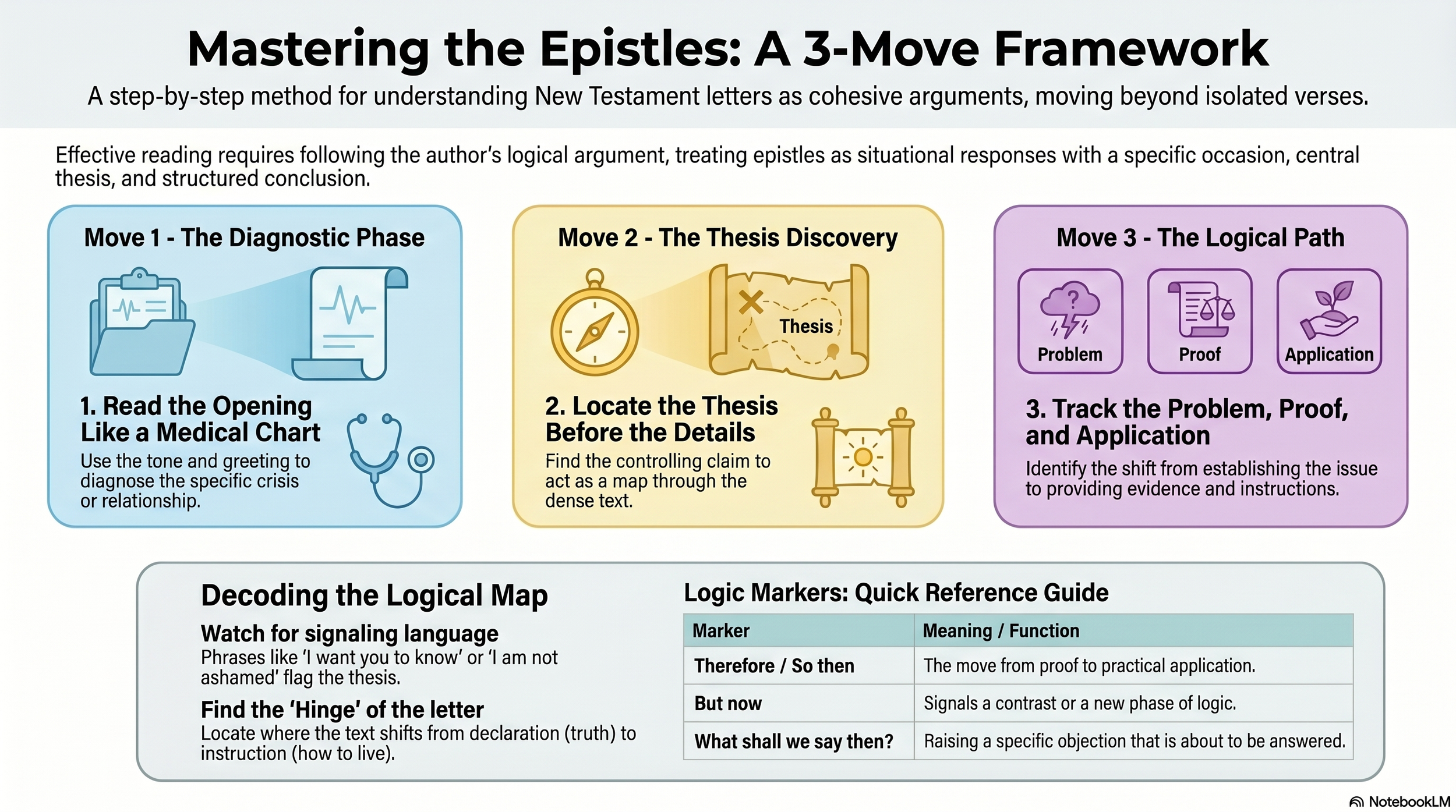
Move 1 — Read the Opening Like a Doctor Reads a Chart
DOWNLOAD THE FREE ACTIVITY PAGE AND SMALL GROUP LEADER GUIDE BELOW
Before a doctor treats a patient, she reads the chart. The opening of a Pauline letter is the chart — the tone tells you as much as the content.
Paul’s standard opening tells you who he’s writing to, how he feels about them, and what the relationship is like. Read it like a diagnostic.
Compare two openings. Galatians 1:6: “I am astonished that you are so quickly deserting the one who called you to live in the grace of Christ and are turning to a different gospel.” No thanksgiving. No warm greeting. Paul is alarmed, and he doesn’t hide it.
Now read Philippians 1:3–4: “I thank my God every time I remember you. In all my prayers for all of you, I always pray with joy.” Warmth. Affection. A relationship with deep roots.
Same author. Completely different emotional tone. The openings tell you the occasion before you’ve read a single chapter of content.
In 1 Corinthians 1:11, Paul names his source: “My brothers and sisters, some from Chloe’s household have informed me that there are quarrels among you.” He’s responding to a report. What follows — all sixteen chapters — is Paul working through the specific problems that report described.
When you read the opening carefully, you stop reading the letter in the abstract. You start reading it as a response.
Move 2 — Find the Thesis Before You Study the Details
Every Pauline letter has a controlling claim. Find it before you study the details, or the details won’t hold together.
In Galatians, the thesis arrives early and with force. Galatians 1:11–12: “I want you to know, brothers and sisters, that the gospel I preached is not of human origin. I did not receive it from any man, nor was I taught it; I received it by revelation from Jesus Christ.”
Everything that follows — the autobiography of chapters 1–2, the Abraham argument of chapter 3, the allegory of chapter 4, the freedom passages of chapters 5–6 — is Paul defending and unpacking that single claim. His gospel came from Christ, not from the Jerusalem church, not from any human authority, and certainly not from the Judaizers who arrived after him.
Romans gives you a thesis just as clear. Romans 1:16–17: “For I am not ashamed of the gospel, because it is the power of God that brings salvation to everyone who believes: first to the Jew, then to the Gentile. For in the gospel the righteousness of God is revealed.” Everything in Romans — the diagnosis of sin in chapters 1–3, justification by faith in chapters 3–4, life in the Spirit in chapters 5–8, the question of Israel in chapters 9–11, the ethics of chapters 12–16 — unpacks that thesis.
Not sure if you’ve found the thesis? Three quick tests:
Look for Paul’s signaling language — phrases like “I want you to know” or “I am not ashamed” are Paul flagging a direct claim. A few places to see this in action: Galatians 1:11, Romans 1:16, 1 Corinthians 15:1, Philippians 1:12.
Ask what Paul is defending. The thesis is usually whatever his opponents are attacking.
Test your candidate against the whole letter. Does every major section flow from this claim? If yes, you’ve found it. If chapters keep surprising you, keep looking.
Find the thesis and you have a map. Without the map, you’re wandering through a very dense forest.
Move 3 — Follow the Argument’s Three Moves
Paul’s arguments follow a consistent pattern: problem, proof, application. When you see that pattern, the letter opens up.
Walk through Galatians and the pattern is unmistakable:
Chapters 1–2 establish the problem: a different gospel has arrived, Paul’s authority has been challenged, and even Peter compromised at Antioch. The situation is serious.
Chapters 3–4 provide the proof: Abraham was justified by faith before the law existed — Genesis 15:6 precedes Sinai by 430 years. The law was never meant to be the basis of right standing with God; it was a temporary guardian pointing toward Christ.
Chapters 5–6 deliver the application: since Christ has set you free, live by the Spirit. Don’t use your freedom as an excuse for sin, but don’t submit again to a yoke of slavery either.
Learning to spot where the argument turns is half the work. Paul leaves markers:
“Therefore” / “So then” signals the move from proof to application. When you see it, Paul is done building his case and ready to tell you what to do with it. Romans 12:1 is the clearest example in his letters.
“But now” signals a contrast or a new phase of the argument. Romans 3:21 uses it to pivot from the diagnosis of sin to the announcement of righteousness.
“What shall we say then?” is Paul raising an objection he’s about to answer. It appears six times in Romans alone (6:1, 7:7, 8:31, 9:14, 9:30, 11:7) and tells you the argument is turning a corner.
A shift from declaration to instruction — Paul spends the first half of many letters telling you what God has done, then shifts to telling you how to live in light of it. Romans 1–11 is declaration: here is the gospel, here is sin, here is justification, here is life in the Spirit. Romans 12 opens with “Therefore, I urge you” and doesn’t stop instructing until the end of the letter. Galatians runs the same pattern. When you feel the letter shift from “this is true about you” to “this is how you must live,” you’ve found the hinge.
You can see the same three-move structure in Philippians, though compressed. The problem: anxiety, disunity, and the threat of those who preach circumcision (3:2). The proof: Paul’s own story of trading religious credentials for the righteousness that comes through faith (3:4–11). The application: “rejoice” — and “the peace of God, which transcends all understanding, will guard your hearts and your minds in Christ Jesus” (4:7). In Philippians, the anxiety is real — but the argument earns the peace Paul promises.
Follow the three moves and you’ll stop reading epistles as collections of quotable lines. You’ll read them as arguments. That’s what they are.
Why This Changes the Famous Verses
The real test of any reading method is what it does to familiar territory.
Galatians 5:1 is one of Paul’s most quoted lines: “It is for freedom that Christ has set us free. Stand firm, then, and do not let yourselves be burdened again by a yoke of slavery.”
Read in isolation, it’s a general statement about Christian freedom. Read as the conclusion to four chapters of argument — after Paul has established that the Galatians were enslaved to the law, that Abraham’s faith preceded the law, that the law was a temporary guardian, that Christ redeemed those under the law — it’s a declaration that lands with weight.
The same is true for Galatians 2:20: “I have been crucified with Christ and I no longer live, but Christ lives in me.” Read as a standalone verse, it’s moving. Read as Paul’s personal testimony in the middle of a legal argument about justification, it’s his evidence — this is what the gospel I preach has done in my own life.
Or consider 1 Corinthians 13, the love chapter. Read at weddings and funerals, it sounds like a timeless meditation on love. Read in context — between chapters 12 and 14, which address the Corinthians’ prideful competition over spiritual gifts — it’s a corrective. Paul is telling a church that has turned spiritual gifts into a status competition that love outranks every gift they’re fighting over. The poetry lands differently when you know it’s aimed at a specific wound.
Context doesn’t diminish the verse. It deepens it.
A Simple Practice for Your Next Epistle
Before you study your next Pauline letter, do four things.
Read the whole letter in one sitting. Paul wrote it to be read aloud in a single gathering — resist the instinct to break it into daily devotional portions until you’ve read it whole at least once.
Write one sentence describing the occasion. What problem, question, or crisis prompted this letter? Even a rough answer reorients everything.
Underline what you think is the thesis. You may be wrong. That’s fine. Having a working thesis sharpens your reading and gives you something to revise as you go.
Note where the argument shifts from problem to proof to application. In Galatians, chapter 3 is the hinge. In Philippians, chapter 3. In Romans, the shift begins around chapter 5. These transitions are Paul signaling where the argument is going.
If you’re new to this approach, start with Galatians or Philippians. Both are short enough to read in a single sitting, and both have visible argument structures that reward this method. As you build the skill, the longer letters — Romans, 1 Corinthians — will open in ways they haven’t before.
For the inductive framework that supports this kind of reading, see Week 2: The 3-Step Inductive Bible Study Method. And if you want help developing great questions that drive your group deeper into the text, Week 5: The Power of Asking Great Questions in Bible Study is a natural next step.
Paul wrote to real communities in real crisis. His letters carried the weight of the gospel across the first-century world because they made arguments that held together — arguments that the Galatians, the Corinthians, the Philippians, and the Romans needed to hear.
When you follow the argument instead of mining the verses, you meet Paul as a thinker and a pastor. And you meet the gospel he carried as something more than inspiration.
That’s a different kind of encounter with Scripture — and it’s available every time you open a letter and decide to follow where it leads.
You meet it as truth.
——
FYI: Some of the links above are affiliate links. If you choose to purchase items linked, I will receive a small commission from that sale.
If you find this blog helpful and want to say thanks, click here to buy Danny Davis a coffee.
