

How to Do a Word Study: One Word, Eleven Times
Abide in Christ: A Simple Word Study Method from John 15 That Deepens Your Bible Study
The night before his arrest, Jesus gathered his disciples in an upper room and began to speak. He knew what was coming. They didn’t.
He had hours left with them. One thing to carry into whatever followed. Not a strategy. Not a survival plan. A word. And he said it eleven times in eleven verses.
Remain in me, as I also remain in you. (John 15:4)
The word is menō — the Greek term your Bible most likely translates as “remain” or “abide.” When you notice that Jesus uses it eleven times in John 15:1–11, you’re standing at the entrance to a word study worth your time — and learning how to do a word study well starts here.
That’s what this post is about. Not the word itself — though we’ll spend time there. The method that takes you inside it.
If you're new to Bible study, start with our Complete Beginner's Guide to studying the Bible.

Click on the image to ORDER Kingdom Revolution (eBook & Paperback) from Amazon today!!
What a Word Study Is
Word studies have a reputation problem. Mention them in a Bible study group, and half the room assumes you need a seminary degree. The other half has already opened a concordance app and started chasing rabbit trails.
Neither gets you very far.
A word study is what happens when a reader notices something and refuses to keep moving. It doesn’t require a seminary degree or a concordance to begin.
Three signals tell you a word is worth studying:
Repetition. When a writer uses the same word eleven times in eleven verses, they’re not being redundant. They’re showing you where to look. Menō in John 15 is a signal flare.
Translation variation. Open four English translations of the same verse and find four different words. The ESV says “abide.” The NIV says “remain.” The KJV says “abide.” The Message says, “Make your home in me.” When translators diverge, something in the original is resisting easy transfer — and that resistance is worth examining.
Unfamiliarity. When a word or concept stops you, when you read a phrase and realize you don’t know what it means, that’s an invitation, not an obstacle.
Menō triggers the first two. That’s enough to begin.
If you’ve ever wondered what “abide” means in John 15, this is where the answer begins.
Here’s the method — four steps, no Greek required.
The 4-Step Method
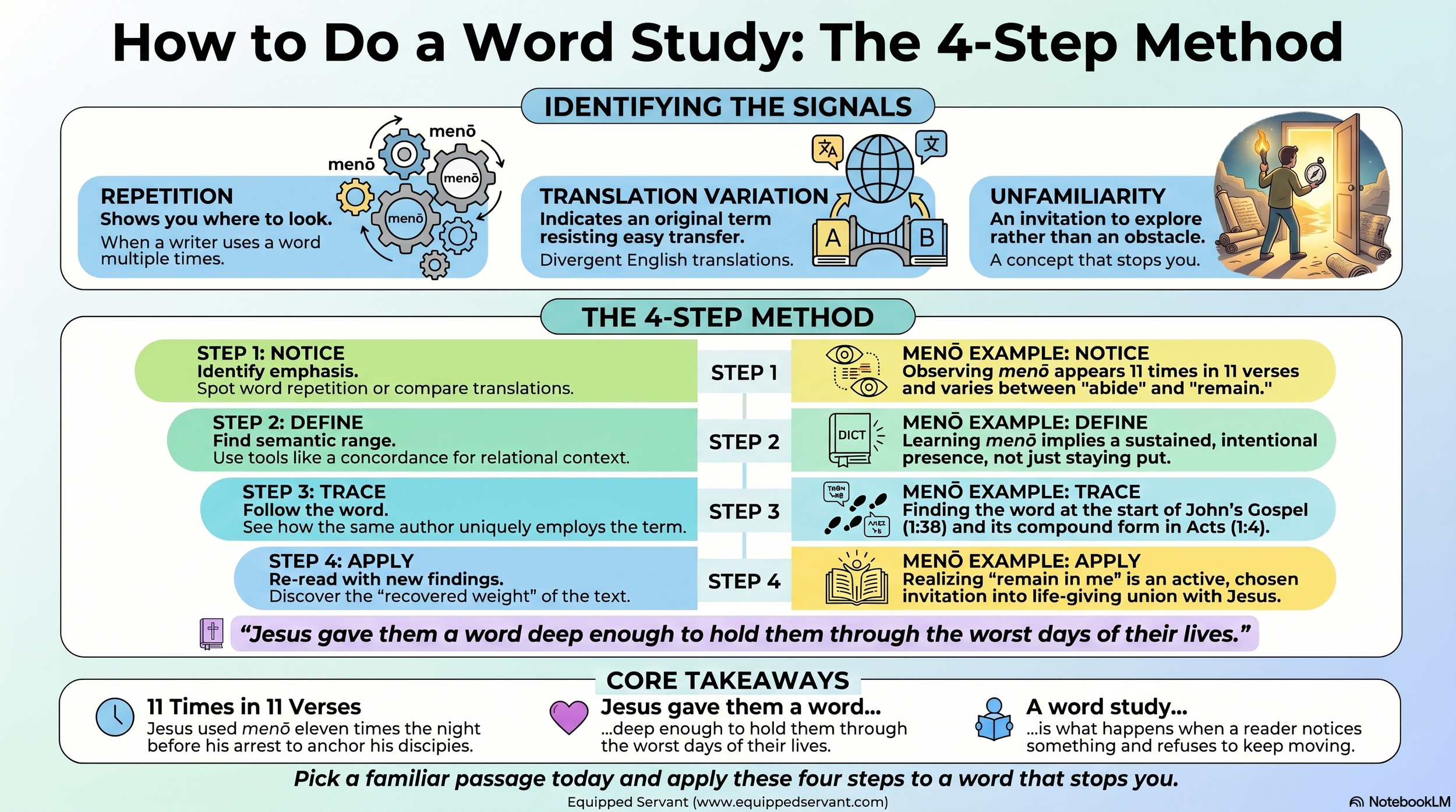
Step 1 — Notice
You’ve already done this with menō. Eleven uses, eleven verses. The repetition shows you where the writer’s weight lies.
But noticing goes deeper than counting. Read John 15:1–11 in two different translations side by side. The NIV and ESV both handle menō consistently, but the moment you see “make your home in me” in The Message, a question opens up: what kind of remaining is Jesus describing? That question is the beginning of a word study.
Most readers read past this. They register the word, absorb the meaning, and move on. The discipline is refusing to do that — staying with the question until the text answers it.
Step 2 — Define
This is where a tool like Blue Letter Bible earns its place in your study toolkit. Search the passage, click the Greek term, and you’ll find menō (G3306) with its semantic range.
Menō doesn’t mean “stay put” in the static, positional sense the English “remain” implies. It carries the sense of sustained, intentional presence within a relationship — a guest settling into someone’s home, a commitment that continues rather than fades, a connection that holds under pressure.
Two uses outside John 15 sharpen the definition. In John 1:32–33, the Spirit descends on Jesus at his baptism and stays — menō. Not a visitation. A taking up of residence. In John 1:39, when the first disciples ask Jesus where he is staying, he says, “Come and see,” and they remained with him that day. Menō again. The word is already doing relational, not positional, work.
One caution worth naming: some readers discover the root of menō and conclude it implies indwelling regardless of the believer’s response — a kind of spiritual maintenance that runs on its own. But notice that in verse 4, Jesus uses menō as an imperative: remain in me. A command requires a response. Remaining, in Jesus’s framing, is something you actively do — not something that happens to you. Context corrects the root.
Step 3 — Trace
Once you have a working definition, trace the word through the same author’s writing. You’re looking for the way this writer uses this word, which is more reliable than a dictionary definition alone.
Two traces illuminate menō from opposite ends of John’s narrative.
John 1:38–39. The disciples’ first question to Jesus in this Gospel is: “Where are you staying?” (menō). The first use of the word in John is a discipleship question. The answer is an invitation: “Come and see.” They went, and they remained with him that day. The Gospel of John begins with people wanting to know where Jesus menō — and ends with Jesus commanding his followers to menō in him. The word frames everything between.
Acts 1:4. Days after the resurrection, Jesus tells his disciples to wait in Jerusalem for the promised Spirit. The Greek is perimenoō — a compound of menō, with the same root now shading toward expectant waiting. The disciples commanded to remain in Jesus are now commanded to wait expectantly in Jerusalem until the Spirit comes. The word that defined their relationship with Jesus now defines their posture in the days before Pentecost.
This is what tracing does. It shows you that menō isn’t a passing metaphor. It’s a thread running through John’s entire account of Jesus’s ministry and into the early church.
Step 4 — Apply
Return to John 15:1–11. Read it again, this time with everything you’ve found.
Remain in me is no longer a positional instruction — stay connected, don’t drift. It’s an invitation into sustained, intentional, life-giving union with Jesus. The vine metaphor carries its full weight now: branches don’t maintain their connection to the vine by willpower. A branch that doesn’t remain in the vine can’t bear fruit. There’s no neutral option.
And the command lands differently. Jesus isn’t describing a state his followers will automatically inhabit. He’s calling them to something — active, ongoing, chosen. The night before everything falls apart, he tells them the one thing they need: remain. Not perform. Not survive. Remain.
What does the passage say now that it didn’t say before? That’s the question every word study is trying to answer. When the answer arrives, you’ll know.
What the Method Is For
The disciples carried menō into everything that followed. The arrest. The trial. The silence of Saturday. The empty tomb. The upper room appearances. And finally Pentecost — where the Spirit remained on the church the way he had remained on Jesus at the Jordan.
Jesus didn’t deliver a theology lecture the night before his arrest. He gave them a word deep enough to hold them through the worst days of their lives and the best ones that followed. That’s the kind of work a word study surfaces — not new information, but recovered weight.
What the text was already saying, with a weight the English couldn’t fully carry. Not hidden meanings the translators buried. Not knowledge reserved for scholars.
The inductive Bible study method trains you to observe before you interpret — and word studies are where that observation goes deep. When you learn to ask what a word means, trace how a writer uses it, and return to the passage with that fuller understanding, you’re doing what readers have always done: paying attention until the text opens.
Your Turn
Pick a passage you know well — one you’ve read enough times that it feels familiar. Run the four steps on a word that repeats, or resists translation, or stops you.
Notice. Define. Trace. Apply.
The disciples were told to wait in Jerusalem and pay attention. Something was coming that would make sense of everything they’d experienced. A word study works the same way — you slow down, you look carefully, and you wait for the passage to open.
The inductive Bible study method pairs well with this approach — observation is where every word study begins.
——
FYI: Some of the links above are affiliate links. If you choose to purchase items linked, I will receive a small commission from that sale.
If you find this blog helpful and want to say thanks, click here to buy Danny Davis a coffee.
